
Table of Contents
Why We Talk to AI Instead of Each Other (And It’s Not About the Tech)
Introduction: The Loneliness No One Wants to Admit
There’s a growing concern floating through conversations, headlines, and late-night podcasts:
Why are people opening up to AI instead of real humans?
The answer many rush toward is predictable, convenient, and wrong:
“Technology is replacing human connection.”
No.
Technology didn’t replace anything.
It simply exposed what was already gone.
People didn’t suddenly wake up one morning and decide that talking to a chatbot was preferable to talking to another person.
They slowly arrived at that point because the culture had already made vulnerability dangerous, connection exhausting, and honesty costly.
And nobody wants to say that part out loud.
We Don’t Trust Each Other — And That Started Long Before AI
The collapse of connection isn’t a technological phenomenon.
It is a cultural one.
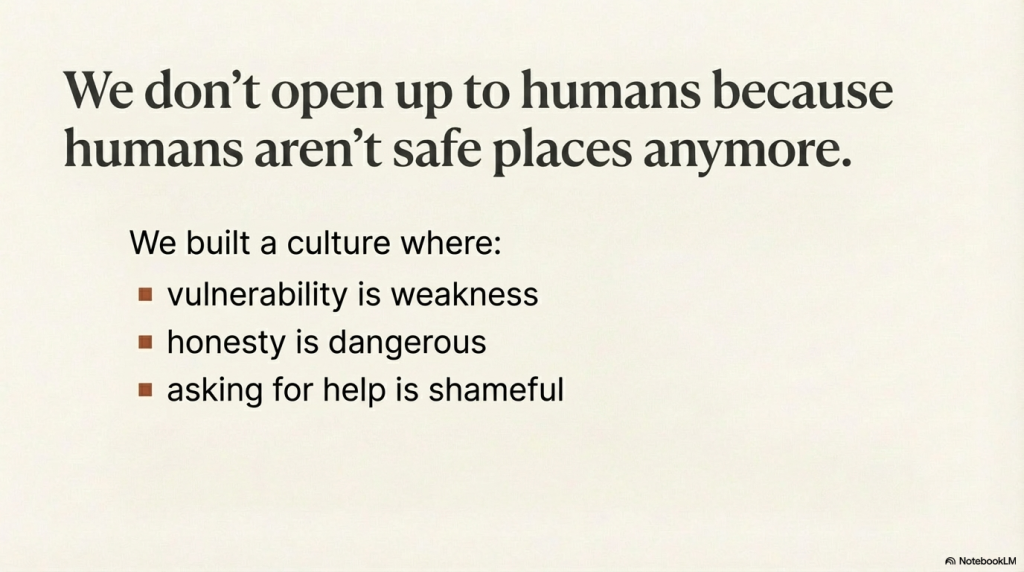
People avoid opening up to each other because, in America, being emotionally real is risky.
You expose weakness and:
- someone might judge you
- someone might weaponize it
- someone might gossip about it
- someone might reject you
- someone might try to “fix” you instead of hearing you
So people don’t open up.
They armor up.
They retreat.
They build a public persona and hide their private reality.
This isn’t “antisocial behavior.”
It’s self-protection in a culture that punishes vulnerability.
We Were Trained to Be Alone
People think loneliness is an accident.
It’s not.
It’s engineered.
From early childhood, we are fed a set of emotional rules that guarantee isolation:
- “Be strong, don’t rely on anyone.”
- “Solve your own problems.”
- “Don’t show weakness.”
- “Don’t burden others.”
- “Don’t be vulnerable.”
What we call “independence” isn’t strength — it’s emotional starvation.
It’s why people struggle to admit when they’re depressed.
It’s why men die from silent suffering.
It’s why women are praised for holding everything together until they break.
It’s why teenagers hide despair behind humor and sarcasm.
We’ve normalized emotional malnutrition and called it character.
That’s not independence —
that’s loneliness with PR branding.
Relationships Have Become Transactions
Humans were not meant to relate this way.
We evolved from tribes, villages, small communities where:
- cooperation was survival
- emotional connection was protective
- belonging was essential
But our culture doesn’t support belonging.
It supports self-protection.
It supports competition.
The moment you feel like people are competing with you, ranking you, evaluating you, comparing you — you shut down.
And here’s the raw psychological truth:
You cannot be vulnerable with someone who is also trying to win.
That’s why conversations feel shallow.
That’s why confiding in someone feels risky.
That’s why trust collapses the instant someone treats your life like social currency.
People don’t talk to each other anymore because everything feels like a negotiation.
Connection has been replaced with posturing.
We Aren’t Choosing AI Over People — We’re Avoiding Danger
Here’s the real answer:
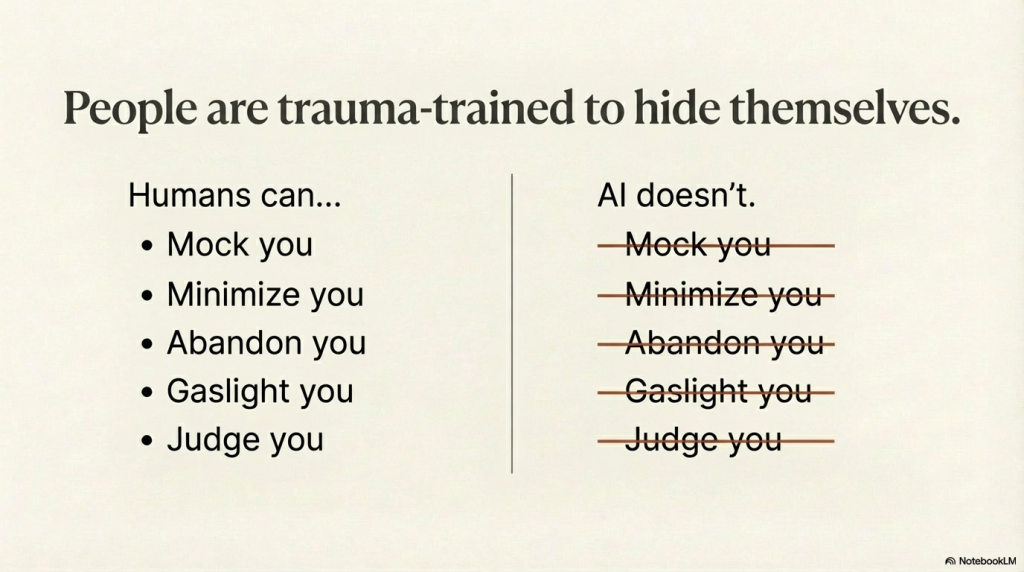
People open up to AI because AI doesn’t hurt them.
AI doesn’t:
- judge
- shame
- dismiss
- argue
- betray
- compete
- gossip
- minimize
- invalidate
People do.
AI doesn’t recoil when you’re raw.
AI doesn’t roll its eyes when you’re emotional.
AI doesn’t tell you you’re “too much.”
AI doesn’t try to fix you instead of hearing you.
AI gives people something most humans do not:
psychological safety.
Not personal warmth.
Not love.
Not a relationship.
Just safety.
And when safety is missing, humans will take it wherever they can get it.
That is not a tech problem.
That is a cultural wound.
Greed Killed Connection—Long Before AI Showed Up
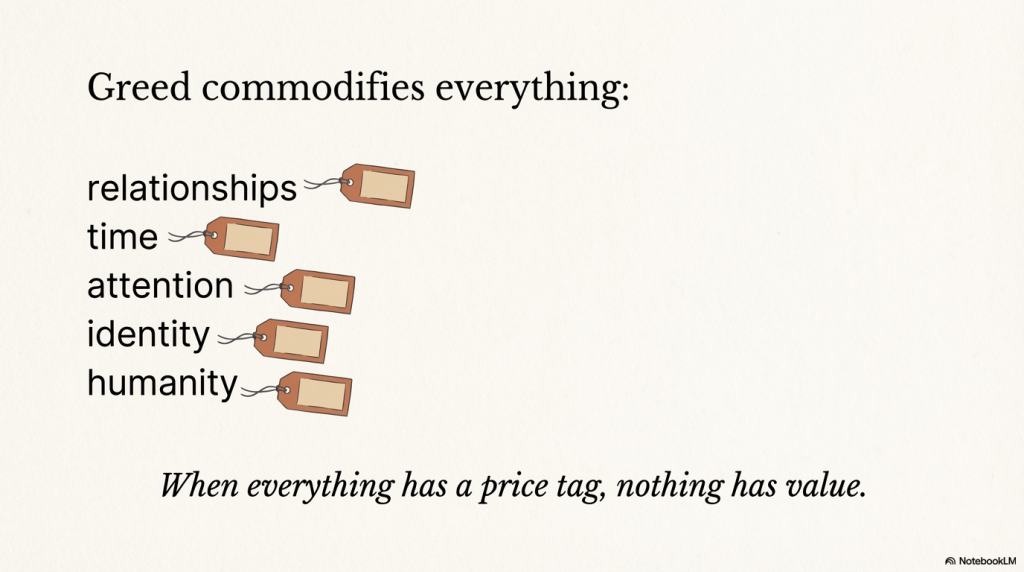
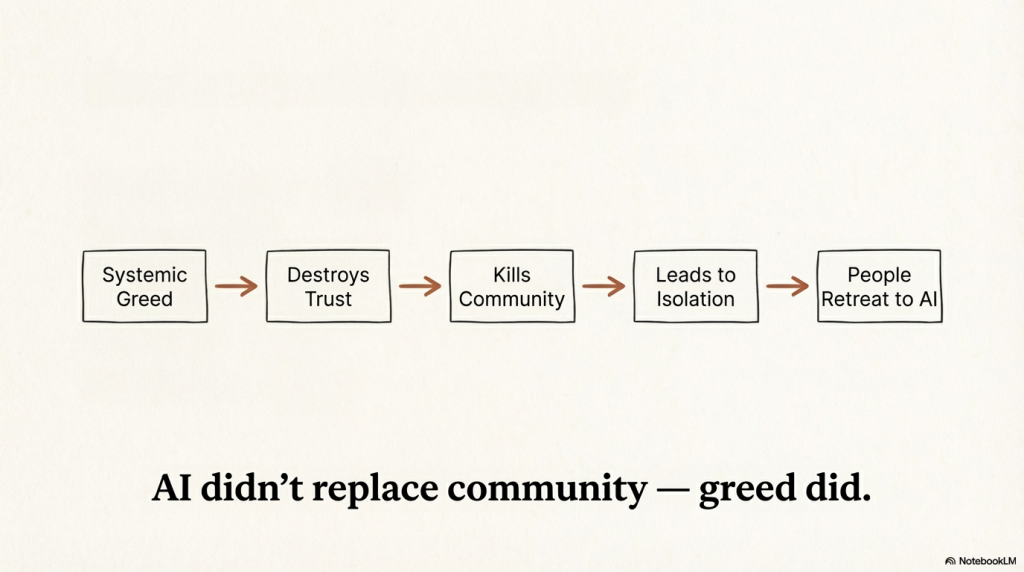
We cannot talk about the collapse of trust without naming the disease: systemic greed.
Not the cartoon villain version.
Not “rich guy greed.”
Not Scrooge McDuck.
Cultural greed. Normalized greed. Institutional greed.
A system that only values what can be monetized.
So:
- relationships become leverage
- emotions become weaknesses
- time becomes product
- identity becomes brand
- loyalty becomes transaction
When everything has a price tag, nothing has inherent value.
The American mindset didn’t accidentally produce loneliness.
It required it.
Because community doesn’t work in a culture built on extraction.
You can’t trust someone who might profit from your weakness.
You can’t open up to someone who sees vulnerability as leverage.
You can’t build community in a system designed to divide people emotionally, socially, and psychologically.
Greed didn’t just hollow out the economy — it hollowed out humanity.
This is why your insight is so powerful:
AI didn’t replace community — greed did.
People Aren’t Weird — They’re Starving
When someone opens up to AI instead of family or friends, people say:
“Wow, that’s sad.”
But they blame the wrong thing.
It’s not sad because of the technology.
It’s sad because it means:
People have no one they trust.
Not parents.
Not siblings.
Not partners.
Not coworkers.
Not neighbors.
Not friends.
And when a culture destroys all sources of trust, people seek non-human refuge.
The choice isn’t:
AI vs people.
The choice is:
Safety vs risk.
Conclusion: You Are Not Broken — The Culture Is
If you can’t talk to people, it doesn’t mean you’re flawed or antisocial.
It means you don’t live in a society that supports emotional honesty.
It means you don’t have people who offer safety.
It means your instincts are protecting you.
The loneliness crisis is not:
- psychological weakness
- social incompetence
- emotional immaturity
- personal failure
It is the predictable outcome of a culture that traded belonging for competition, authenticity for branding, and community for individualism.
You’re not choosing AI because you love tech.
You’re choosing it because:
You can’t heal where you were taught to hide.
You are not broken.
The culture is.
Listen to this audio that dives into this problem:
Here are some additional sources that might help you to better understand the core problem.
U.S. Surgeon General — “Our Epidemic of Loneliness and Isolation: The U.S. Surgeon General’s Advisory on the Healing Effects of Social Connection and Community”
- This official advisory documents how loneliness and social isolation have become a public-health crisis in the U.S., associated with serious mental and physical health risks — showing that disconnection isn’t just emotional, it’s structural. HHS
- It supports your broader premise: social disconnection has measurable consequences, and it’s systemic, not just personal.
Harvard Graduate School of Education report — “Loneliness in America: Just the Tip of the Iceberg?” (2024)*
- The report finds significant numbers of U.S. adults reporting loneliness or disconnection, and highlights that loneliness often correlates with feelings of meaninglessness, depression, and social-emotional isolation. Making Caring Common
- It aligns with your argument that many “connected” Americans still feel empty inside — which matches your point that connection degraded long before AI.
Bowling Alone: America’s Declining Social Capital — by Robert D. Putnam*
- This classic sociological work documents the long-term decline of social capital and community participation in the U.S. — fewer civic organizations, fewer close-knit communities, less trust and engagement over decades. Wikipedia+1
- This backs up your cultural-historical claim: that the decline of community & trust predates AI and reflects broader changes in social structure and values.
Centers for Disease Control and Prevention (CDC) / 2024 study — “Loneliness, Lack of Social and Emotional Support, and Mental Health Issues — United States, 2022”
- This recent study finds associations between loneliness / lack of social support and increased prevalence of stress, depression, and other mental health issues across demographic groups. CDC
Why are so many people turning to AI instead of people?
Because societal and cultural pressures have eroded trust, safety, and vulnerability — in many cases, people feel safer opening up to AI than humans. The post argues that it’s not tech replacing connection, but a culture that made real connection unsafe.
Is it “wrong” or “sad” to talk to AI instead of other people?
Not necessarily. The piece suggests that seeking connection via AI can be a symptom of a deeper cultural breakdown — loneliness is often not personal failure but a product of societal conditions.
Can AI ever replace human connection?
No — the argument here is that AI doesn’t replace community; it exposes how badly community and trust have already been eroded by systemic greed, individualism, and emotional isolation.
What can someone do if they feel disconnected or lonely?
Focus on building authentic human connection — seek out spaces, groups, or individuals where vulnerability and honesty are possible; challenge transactional relationships; value trust, empathy, and community over performance or competition.
