
Table of Contents

What I Learned as a Raft Guide: You Can’t Pull Yourself Up by Your Bootstraps in a Raging River
The bootstrap myth. The American ideal of “pulling yourself up by your bootstraps” is woven deep into our cultural fabric. It’s a story of rugged individualism, a belief that with enough grit and hard work, anyone can overcome their circumstances and succeed. It’s a powerful narrative, but one that feels increasingly disconnected from reality.
I used to be a raft guide, and the lessons I learned navigating powerful currents with a boat full of people offered a potent counter-narrative. On the water, abstract ideals about self-reliance are put to a very real, very humbling test. So what happens when the bootstrap myth meets the unyielding force of a whitewater river?
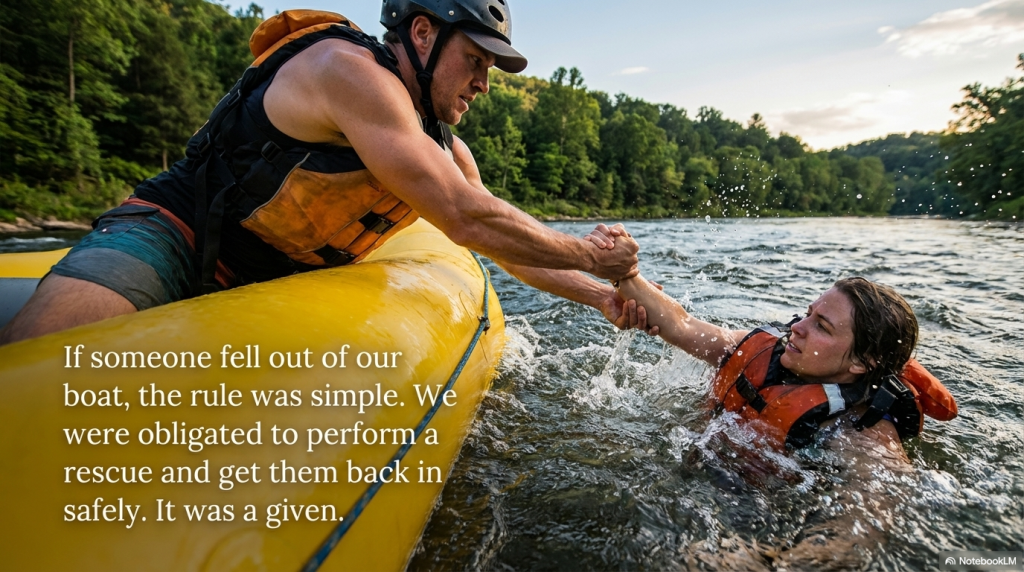
1. Helping Isn’t a Choice; It’s a Duty
As a raft guide, the cardinal rule was simple: if someone falls out of the boat, you are obligated to perform a rescue. It isn’t a matter for debate or a judgment on their swimming ability; it is a fundamental duty. Your job is to get them back in the boat.
If I were a guide today and applied the logic of our modern discourse, I suppose I would just yell at them to “pull up their bootstraps” and “work hard.” Yep, you just need to “work hard!!” to get out of your situation. The absurdity of this is self-evident, yet it’s precisely how we treat millions who “fall out of the boat in life.” They are met not with an immediate rescue but with ridicule, told that their struggle is a personal failing. This reframes the entire issue: it shifts the focus from an individual’s supposed moral failure to our collective, systemic responsibility to pull each other back to safety.
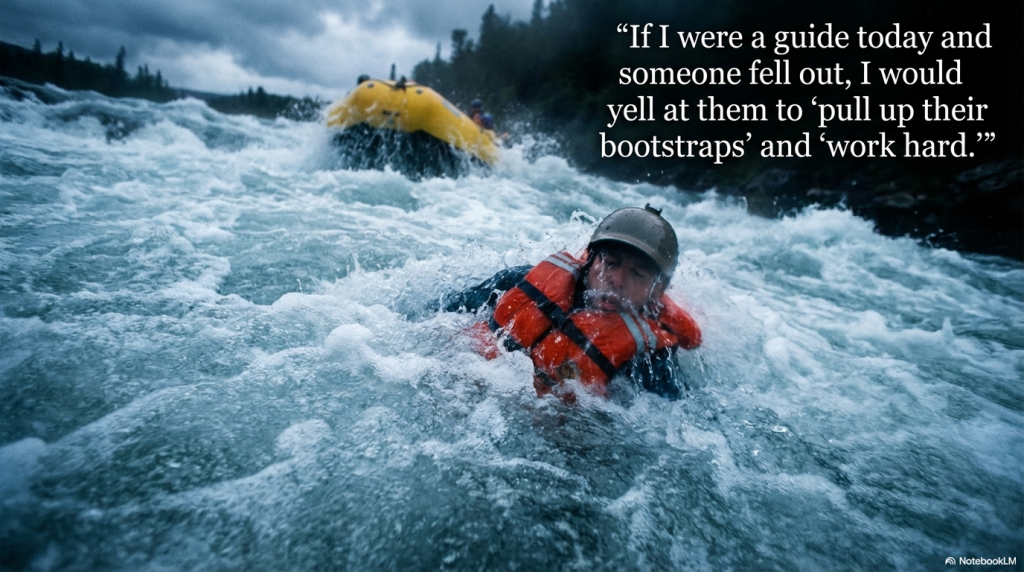
2. The Real Problem Isn’t Falling Out—It’s Forgetting the Current
The core issue isn’t the people who fall overboard. The real problem comes from those who preach self-reliance from a place of unexamined privilege, mistaking their gifted starting position for personal virtue. It is this group that is most blind to the real currents affecting others.
The advice to “pull up your bootstraps” and “work harder” is almost always delivered by those who “are usually already gifted in some way and don’t fully understand what most people go through and the variables that are out there for everyone.” They judge the frantic swimming of others from the safety of their own well-appointed vessel, oblivious to the forces they never had to fight.
The problem isn’t those that fall out of the boat; the real problem comes from those that think they know how to navigate big water and pull themselves back into the boat.
3. The Most Powerful Force Isn’t Your Will
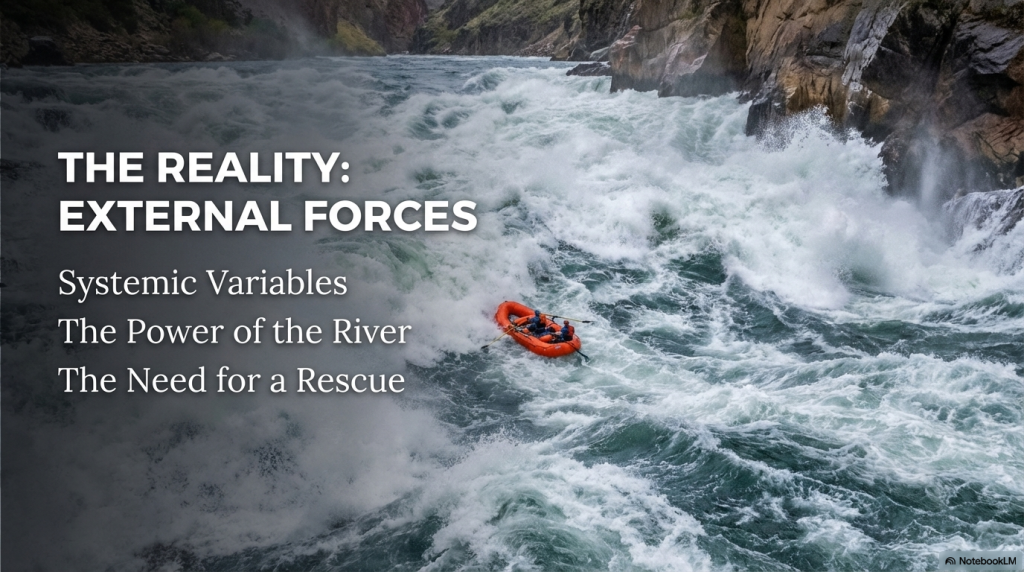
Here is the final, humbling lesson from the world of rafting. No matter how strong a swimmer you are, how determined you are, or how hard you work, there are forces that are simply more powerful than any single individual. The river has its own will.
You can do everything right—paddle hard, follow instructions, and maintain your balance—and still be thrown from the boat by a force beyond your control. In those moments, individual effort reaches its limit. Survival depends on the guide, the boat, and the team. To believe otherwise is to deny the fundamental nature of the challenge. There’s a saying that all guides know, and it applies as much to life as it does to the water.
The river always wins.
Conclusion: Back in the Boat
The rafting metaphor doesn’t just challenge a myth; it offers a better model for moving forward. It teaches us about empathy, interconnection, and the profound limits of individualism in the face of overwhelming forces. It reminds us that we are all in the same boat, navigating the same unpredictable river.
Instead of asking why someone fell, what if we just focused on helping them get back in the boat?
Check out this audio discussion I created in NotebookLM to give you some additional perspective of what I’m pointing at.
We Must Banish ‘Bootstraps’ Mythology From American Life
Held down by our bootstraps: The myth of American individualism is a poor excuse for inequality
The “Bootstrap” Myth (Medium / personal essay)
Debunking the ‘Pull Yourself Up By Your Bootstraps’ Myth (Everyday Feminism)
Check out these articles:
The Haves and The Have-Not Culture
- 5 Brutal Truths About Why We Talk to AI Instead of Each Other
- It’s Not in Your Head: The Real Story Behind Shrinkflation and Why You’re Paying More for Less
- The Financial Muzzle: Why Healthcare Experts Don’t Speak Out Against a Harmful System
- Why Your HOA Hates Your Solar Panels (And What It Says About America)
- What I Learned as a Raft Guide. The Bootstrap Myth No One Talks About
