
Table of Contents
1. The Hook: That Shrinking Feeling Is Real
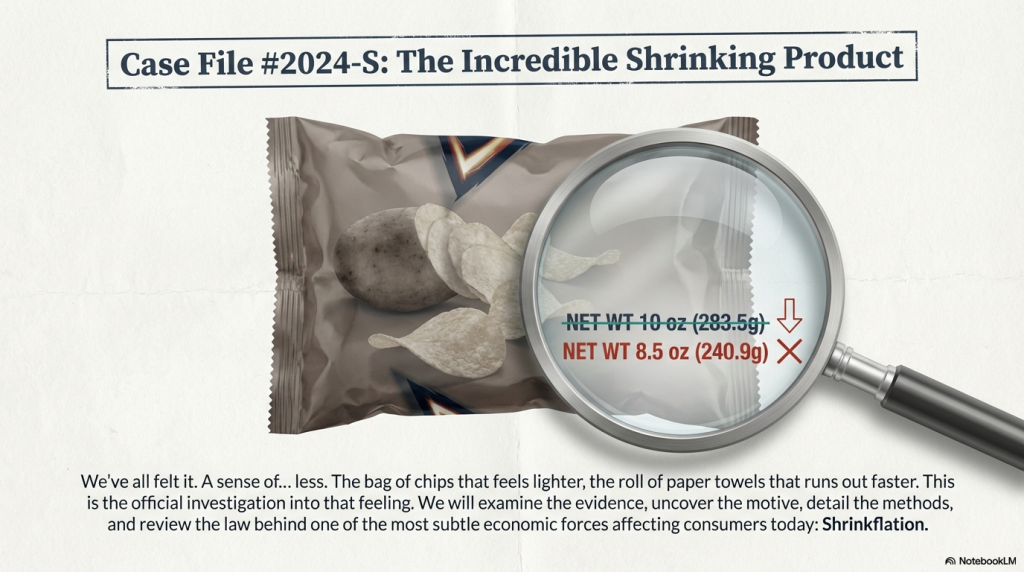
You open a new bag of chips and it feels half-empty, a fresh box of cereal that seems lighter than last time, or a tube of toothpaste that runs out quicker than you remember. You pause for a moment, second-guessing your own memory. Are you just imagining it, or is the world of products quietly shrinking around you?
Let’s be clear: You are not imagining it. This phenomenon has a name—shrinkflation—and it isn’t an accident. It’s a deliberate, systemic practice designed to make you pay more for less, and it’s happening in every aisle of the grocery store.
2. The Real Problem Isn’t Inflation—It’s a System Built on Deception
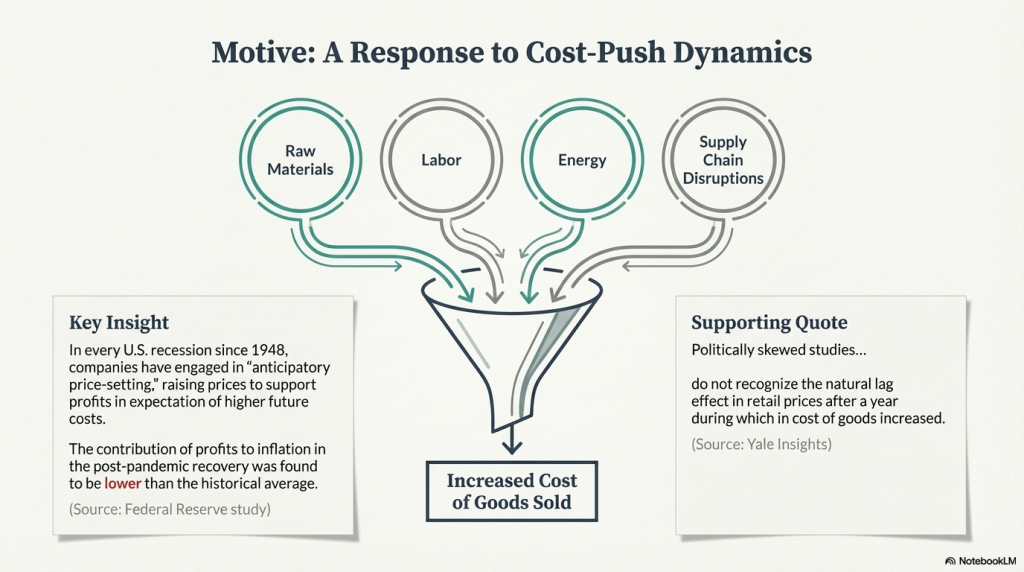
The easy excuse for shrinking products is “rising costs,” but that’s only half the story. The root problem is a corporate culture that consistently prioritizes shareholder profits over consumer value and transparency. Shrinkflation is a strategic choice, not an inevitability. It is a “systemic signal of America’s greed problem,” a pattern where corporations exploit the trust you place in their brands every time you shop.
This practice is not a mistake—it’s a message, and it’s being sent loud and clear: “You won’t notice. And even if you do, what are you going to do about it?”
3. A Glossary for a Rigged Game: Understanding the Tactics
To understand the game, you need to know the terms. Corporations use two primary “stealth” tactics to increase profit margins without the obvious backlash of a direct price hike.
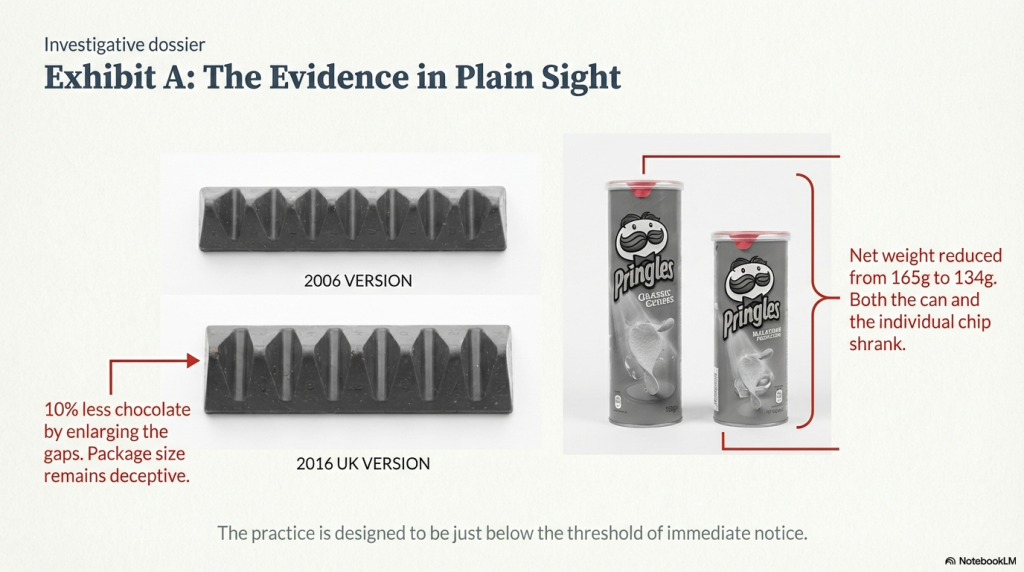
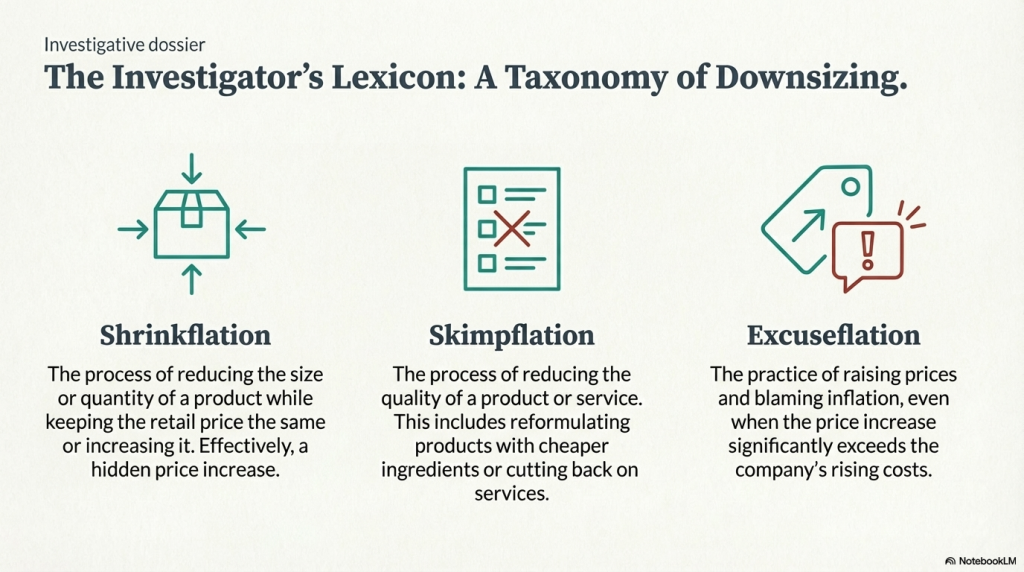
- Shrinkflation: Also known as “package downsizing,” this is the classic move where companies reduce the size or quantity of a product while the price stays the same or even increases. Your bag of chips now has fewer chips; your coffee can has less coffee.
- Skimpflation: This is a related tactic where the quality of a product is secretly reduced. Companies substitute cheaper ingredients to save money, hoping you won’t notice the difference in taste or performance. A stark example is McVitie’s Club and Penguin biscuits, which can no longer be legally described as “chocolate biscuits” because they now contain more palm and shea oil than cocoa.
4. The Evidence Locker: It’s Happening to Almost Everything
This isn’t just about a few missing cookies. According to a LendingTree analysis, about one-third of common consumer products have shrunk since the pandemic began. The practice is widespread, touching nearly every category of consumer goods.
Case Files: How Your Favorite Brands Are Shrinking
| Product | Brand | The Change | The Hidden Cost (Effective Price Increase) |
|---|---|---|---|
| Toothpaste | Aquafresh | Reduced from 100ml to 75ml while the price rose. | 105% |
| Party-size Snacks | Cheetos | Shrank from 17.5 oz to 15 oz; per-ounce price jumped from 17¢ to 40¢. | 135% |
| Crackers | Ritz | Dropped from 200g to 150g for the same price. | 33.3% |
| Sports Drink | Gatorade | Shrank from 32 oz to 28 oz, justified as a “new bottle design.” | 14.3% |
| Toilet Paper | Charmin | Mega Rolls were cut from 264 sheets to 242 sheets. | 9.1% |
| Coffee | Folgers | Cans were reduced from 51 oz to 43.5 oz. | 17.2% |
| Family Size Cereal | Honey Bunches of Oats | “Family Size” box went from 23 oz to 18 oz. | 27.8% |
| Ice Cream | Häagen-Dazs | U.S. “pints” were reduced from 16 oz to 14 oz. | 14.3% |
| Chips | Doritos | Standard bag reduced from 9.75 oz to 9.25 oz. | 5.4% |
| Ice Cream Bars | Klondike Bars | Classic squares shrank from 5 oz to 4 oz. | 25% |
The worst-offending categories are everyday essentials that households buy on repeat: household paper products, breakfast foods, and snacks. These are the items where small changes add up to a significant financial drain over time.
5. The Anatomy of a Deception: How They Get Away With It
Shrinkflation thrives because it is built on a foundation of psychological manipulation, clever packaging, and legal loopholes.
5.1. The Psychology: Weaponizing the “Just-Noticeable Difference”
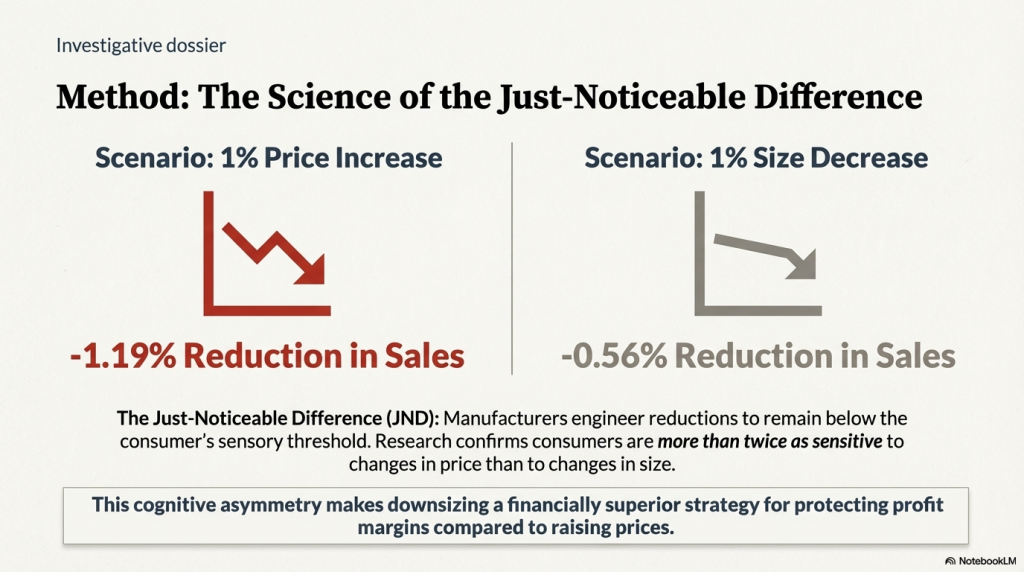
Manufacturers exploit a psychological principle known as the “Just-Noticeable Difference” (JND). This is the minimum amount a stimulus must change for an individual to perceive it. Companies engineer size reductions to be small enough to fly under the average consumer’s radar. Research confirms that consumers are far more sensitive to price changes than to size changes, and corporations use this cognitive blind spot against you.
The data is irrefutable: consumers are more than twice as sensitive to price hikes as they are to size reductions. One comprehensive study found that a 1% increase in price reduces sales by 1.19%, while a 1% decrease in size reduces sales by only 0.56%. This is exactly why corporations choose the stealthier tactic.
5.2. The Packaging: Hiding the Truth in Plain Sight
Packaging is the primary tool of deception. Brands use several tactics to mask downsizing and prevent you from making a direct comparison:
- Same Size, Less Inside: The most common trick is keeping the box or bag the exact same physical size while simply putting less product inside.
- Container Shape-Shifting: A subtle dimple added to the bottom of a glass jar or a new, curvier bottle shape can reduce volume while appearing unchanged.
- Misleading Size Names: Brands increasingly use meaningless terms like “Family Size,” “Party Size,” or “Mega” on progressively smaller packages, training consumers to grab a familiar label instead of checking the net weight.
5.3. The Law: A Loophole Big Enough for a Corporation to Walk Through
In the United States, shrinkflation is perfectly legal. The Fair Packaging and Labeling Act (FPLA) only requires that manufacturers accurately state the new, smaller net weight on the package. There is no law requiring them to announce or draw attention to the change.
This is a form of passive disclosure that utterly fails to protect consumers. The law itself enables the deception by dictating that this critical information be displayed within the lower 30% of the main package panel—a specific, often-ignored location. The required font size is tied to the package area, ensuring it often remains in the fine print. This legal framework, designed to obscure the very information it purports to share, serves corporate interests, not consumer transparency.
6. Calling Out the Nonsense: “Buyer Beware” is Not a Solution
The common response from industry defenders is that consumers should just be more vigilant—a “buyer beware” argument that places the blame on you.
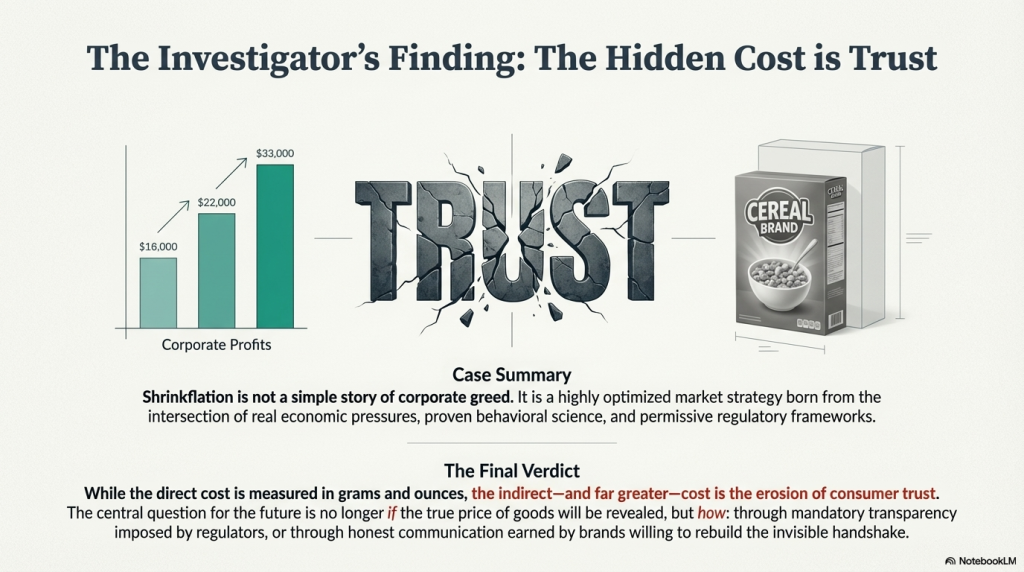
This is nonsense. Telling people to meticulously check the net weight and calculate the unit price for every single item on their shopping list is an unfair and impractical burden, especially when companies are actively designing packaging to be deceptive. Feeling tricked or ripped off is not a failure of diligence on your part; it is a rational response to being systematically misled. The sense of betrayal is real, particularly when a trusted brand you’ve used your entire life quietly downsizes its product without a word.
7. The Pushback: How the World is Starting to Fight Shrinkflation
The good news is that the tide is beginning to turn. Around the world, regulators are shifting from a failed model of passive disclosure to a new standard of active disclosure, forcing this hidden price hike out into the open.
The most powerful example is a new law in France that took effect on July 1, 2024.
- What: Retailers must display a clear, unavoidable notice for two months whenever a product downsizes.
- How: The notice must explicitly state the old quantity, the new quantity, and the resulting percentage increase in the unit price.
- Where: The notice must be placed on or near the product in a font size as large as that used for the indication of the unit price of the product, making it impossible to ignore.
- Why it works: It weaponizes transparency. By forcing the hidden price hike into the open, it empowers consumers to make an informed choice and creates a powerful disincentive for brands to engage in the practice.
Other jurisdictions are following this lead. Australia is considering similar recommendations, the UK is set to introduce new regulations, and the “Shrinkflation Prevention Act” has been proposed in the U.S. Senate.
8. Your Final Takeaway: Trust Your Gut and Demand Better
The next time you get that shrinking feeling, trust it. Your frustration is justified. You are being asked to pay more for less, and the system is designed to make sure you don’t notice.
Shrinkflation is more than a consumer issue; it’s a clear indicator of a broken economic system that values profit extraction over fairness and transparency. But the corporations that benefit from this deception underestimate one thing: you.
The first step is awareness. Share this information with friends and family. Support businesses that practice transparency. And most importantly, advocate for stronger consumer protection laws modeled after the global examples that are finally holding corporations accountable.
Greed shrinks things. But people—especially people who refuse to look away—grow movements.
Sources:
- 7 Products Hit Worst by Shrinkflation
- Shrinkflation: obligation to inform consumers about the products
- Fair Packaging Act
Listen to this audio discussion that points out some important concerns about shrinkflation:
Is shrinkflation legal?
In most places, yes. Companies only have to show the new weight or size on the label. They don’t have to tell you they shrank it, which is exactly why shrinkflation is so widespread.
How can I spot shrinkflation at the store?
Compare the unit price, not just the sticker price. Check net weight, sheet counts, and fluid ounces—even when the package looks the same. Shrinkflation hides in the fine print.
